คำสอน · พระอาจารย์สุรพงค์Teaching · Pra Ajarn Suraphong
วงบุญพิเศษ กายสิทธิ์ และผังสำเร็จ: ถามตอบเชิงลึกเรื่องกลไกแห่งบุญThe Special Merit Circle, Sacred Bodies, and the Completed Plan: An In-Depth Q&A on the Mechanics of Merit
ธรรมบรรยายภาคสายถามตอบเชิงลึกในโครงการธรรมรส ชลบุรี รุ่นที่ 5 พระอาจารย์อธิบายว่าชีวิตไม่เคยว่างเว้นจากการไหลผ่านของพลังงาน จำเป็นต้องเลือกข้างกุศล แนะนำวงบุญพิเศษในสวรรค์ชั้นดุสิตและภารกิจของหลวงปู่วัดปากน้ำ ตอบคำถามเรื่อง 18 กาย กายสิทธิ์ จักรพรรดิ ผังสำเร็จ และปิดท้ายด้วยเรื่องเล่าเด็กหญิงกตัญญูและบทสวดอธิษฐานIn this in-depth morning Q&A session at the fifth Dhamma-rot Chonburi retreat, the teacher explains that life is never free from the flow of energy, requiring us to choose the wholesome side. He introduces the special merit circle in the Tusita heaven and the mission of the elder teacher of Wat Paknam, answers questions on the eighteen bodies, sacred objects (kaya sit), the universal monarch, and the completed plan, closing with the story of a grateful girl and a dedication chant.
The essential thing we need to know is which system we occupy each day, because that system induces its own kind of energy. Our life is never free from this flow of energy — if not , then sin; if not sin, then neutral energy. Even while sleeping, energy flows through us continuously, because each nature contends to induce its own energy, finding ways to overlay us automatically, without giving us any chance to think.
Each nature presses down the entire chain of our elements and bodies
Whenever unwholesomeness possesses us, there must be some issue that causes trouble to ourselves or others — relying on , aversion, delusion, lust, , and unwholesome s to shape us and induce energy to drive its system, pressing our elements downward — not just the human body, but the entire chain of our bodies: subtle body, celestial body, Brahma body, form-Brahma body, body — all pressed down together. If the human body understands nothing at all, unwholesomeness seizes the whole chain unopposed. But whenever wholesomeness possesses us, we are shaped into oneness with it, and good thoughts and feelings arise, while the Triple Gem shines brightly at our center, and the stream of merit flows to refine our elements dimension by dimension. This process happens every day, whether we're aware of it or not — but we need a clear, fixed point for the heart, established through setting intent. Without it, something else will set the intent for us, leading to trouble rather than benefit.
Choosing the wholesome side: knowing both the knowledge and the tools
There are only three systems — if not one, then another. Under neutrality, the heart scatters, unable to settle anywhere, drifting among sights, tastes, smells, sounds, wasting our time and resources carelessly. Once we understand we exist within this endless cycle of three natures, we must choose a side. Seeing that unwholesomeness only brings suffering and neutrality brings no benefit, we choose wholesomeness — and then we must learn its tools, which come down to two things: and tools themselves. Knowledge lets us live correctly and well, inducing merit-energy along with refined treasures and a completed plan; we must develop these tools to work more and more automatically. Our future isn't limited to this one life — it stretches across countless lifetimes, as long as we haven't reached .
The special merit circle: helpers within the auspicious universe
Knowing the path to Nibbāna requires a sufficient proportion of wholesomeness — without it, we cannot overcome unwholesomeness alone, and so we need help. Within the auspicious universe — one where many Buddhas arise, gathering beings of great merit — there exists a circle called the special merit circle (wong bun phiset), Bodhisattvas residing in the Tusita heaven, the gathering place of all Bodhisattvas, including the great Bodhisattva destined to become the next Buddha, such as Metteyya. The special merit circle holds equal standing with these Bodhisattvas because they occupy the same region. Its head is the elder teacher of Wat Paknam Phasicharoen, discoverer of the knowledge of the Buddha — the only knowledge that lets people truly understand the Triple Gem. When it's time to descend and build perfections, an entire merit circle often descends together, both laypeople and monastics, just as other teachers' circles have done in the past.
Human advantages over celestial beings
Though celestial beings enjoy longer lifespans, radiant appearance, and refined happiness, they aren't as suited to building perfections as humans are. The Buddha taught that humans hold three advantages over celestial beings: sharper , bolder courage and effort, and a greater capacity to cultivate celibate practice. This is why Bodhisattvas must descend to the human world to strengthen their perfections further.
Q&A: the eighteen bodies and the four/eight jhāna vehicles
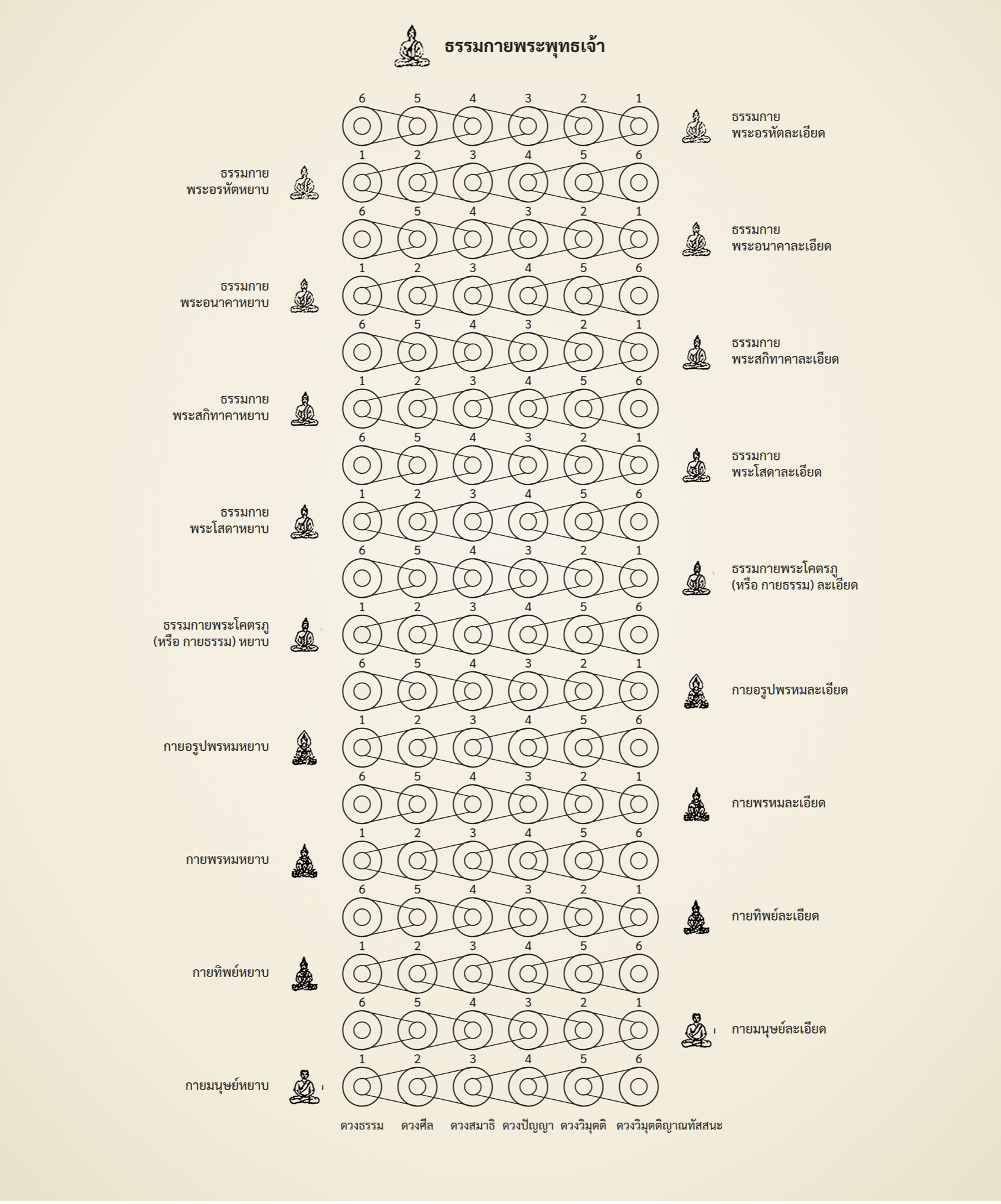
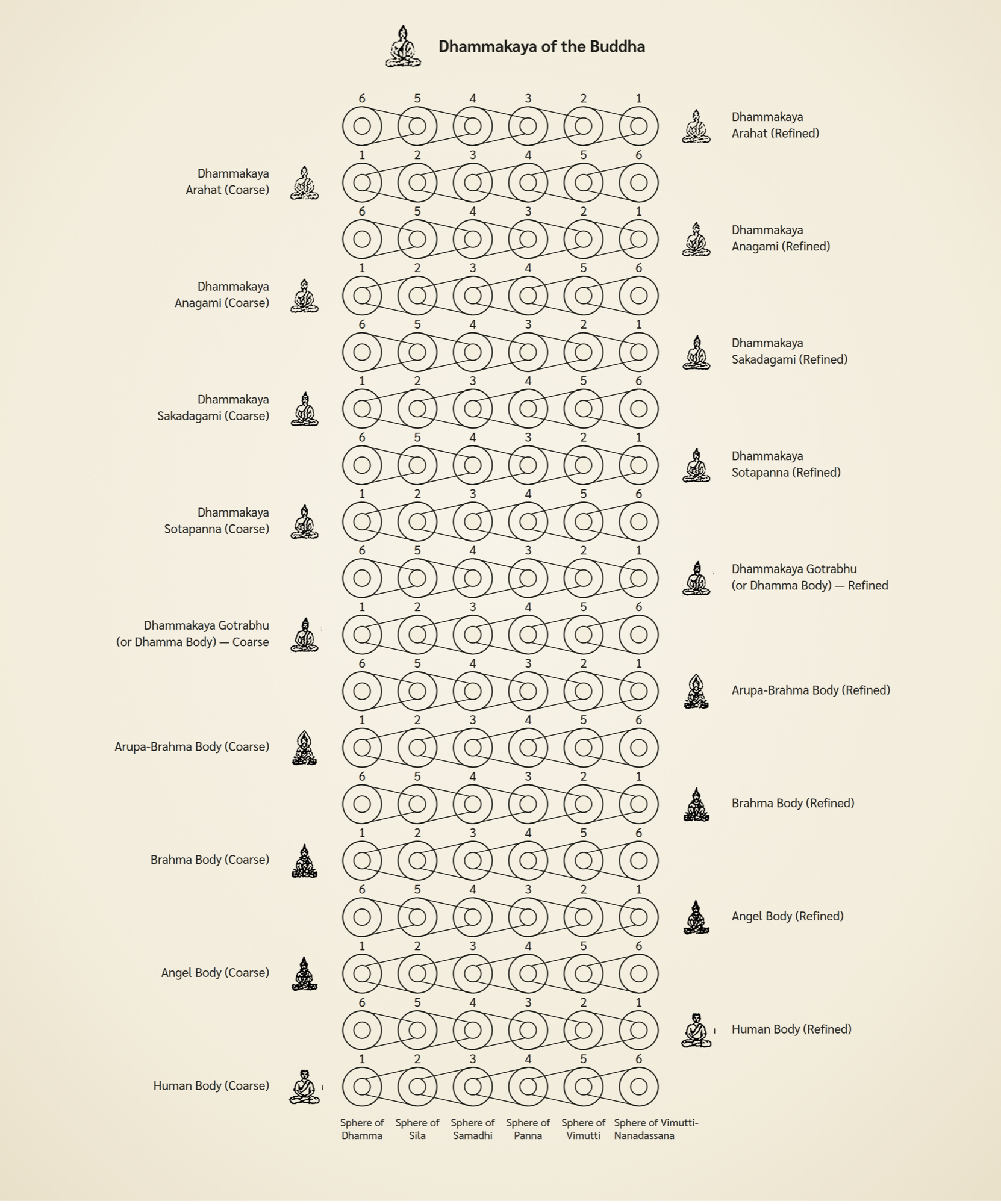
The Dhammakaya of the Buddha — the eighteen bodies
Someone compared the path through the Dhamma-spheres (precepts, concentration, wisdom, liberation, liberating -vision) toward increasingly subtle bodies, up to eighteen bodies, with the four/eight path that reaches only the form-Brahma level. The teacher explained that ñāṇa is an instrument of knowing, while jhāna is an instrument of fixed gazing. Training through gazing-based jhāna only reaches the fourth or eighth jhāna — not our path — because it relies solely on the gazing tool to purify the mind of hindrances, without knowing how to use ñāṇa to connect with . Those who master jhāna develop , lightness, and workability of body and mind until honest — as seen in athletes or musicians who train until they can perform seemingly miraculous feats automatically.
Q&A: psychic powers rely on resolution
Psychic powers (abhiññā) arise through resolution — becoming one with a powerful inner being at a given level. Simply resolving on a desired outcome, the powerful being arranges it accordingly — turning water to ice, walking on water, and so on.
The universal monarch and sacred bodies: the multinational-company analogy
The universal monarch oversees resources and followers from coarse to subtle levels, keeping subordinates honest and unable to embezzle — like a global corporation with thousands of branches worldwide, somehow managing to report accurate profits, all through the mechanism of this monarch. Merit lies behind everything. Even high celestial beings, nearing the end of their lifespan and fearing an unsafe rebirth, must learn from a knower what refuge to take, and so craft a “sacred body” ( sit — carved from Brahma-wood into forms like a cat or a fruit shape), resolving that it protect whoever is reborn in the human world. This sacred object develops across many generations like computer technology, gaining greater quality over time. When someone reaches the Dhamma, their teacher may bring them to request use of these sacred bodies — but on the condition that a portion of merit is given in exchange, not to the object itself but to its true owner, likely the deva who created it.
A story: the grateful nine-year-old girl (revisited)
The teacher recounted again the story of a nine-year-old girl once broadcast on television. Her father fled his gambling debts, her mother suffered paralysis and blindness, and her two older sisters left for Bangkok and never returned. The girl cared for her mother daily — cooking, gathering food from relatives, helping her to the bathroom — despite frequently missing school, she scored perfectly on every exam because she dwelt in gratitude, a wholesome quality that induced merit to cleanse defilement and connect with the inner knower. Local earth-deities in the trees and at her school, seeing the light from her merit-sphere, rejoiced and whispered for teachers to send her to every competition, which she won continuously for over three years. Once her merit reached fullness, word reached a wealthy person in the city, who, deeply moved, sought her out, funded her education, arranged medical care for her mother, and bought them a home — all from just two s: gratitude and repayment of kindness, not from begging for help, but because her correct, good behavior naturally elevated the hearts of those who witnessed it.
One listener shared that his niece, unlike other underperforming children in their large family, always scored first in her class; he recalled she always brought gifts home for her parents and never argued when scolded, instead comforting them — the teacher confirmed this as the fruit of gratitude quietly guiding her.
A story: the mother dog who brought her puppies (revisited)
Another shared the story of a stray mother dog who, starving while her owners traveled, carried her puppies through a fence gap into a kind neighbor's yard; once fed, the puppies ran back to lead their mother in too. The homeowner, moved to tears, raised them all — such images of goodness always induce merit that clears defilement and touches the hearts of those who witness them.
Salaries are already “locked” by the completed plan
The teacher noted that even as a business owner, he couldn't simply set employees' salaries at will — everything is already locked by each person's completed plan, which is why salaries differ so much between people. However, this “spec” can be upgraded through learning and acting on the right causes.
Q&A: paying respects to local spirits versus dedicating merit through giving
Asked about Chinese traditions of burning paper offerings for ancestors, the teacher explained this doesn't actually reach deceased relatives — what occurs is only the practitioner's own gratitude inducing merit, which never reaches its intended destination. This differs from properly inviting monks to make merit and dedicating it, which truly reaches the deceased if they're in a realm capable of receiving it. Without monks or others to give to, one can still establish gratitude in the heart and dedicate that merit directly. Pouring water during dedication is merely symbolic, helping us feel we've truly given. Dedicated merit never disappears — if the recipient cannot receive it yet, it waits for the right opportunity, such as when a deceased relative finishes serving out their karmic sentence in hell, at which point the Lord of Death informs them of merit dedicated to them, combining it with their own to determine their next rebirth.
Q&A: how radiating loving-kindness differs from dedicating merit
Radiating gives energy as a wave, opening a channel for wholesomeness to more easily possess the recipient's heart. Dedicating merit, by contrast, is like a gift box containing , happiness, refined treasures, and a completed plan, sent directly to the recipient.
Q&A: what percentage of merit comes from rejoicing, and the ten bases of merit
Asked what percentage of merit comes from rejoicing in another's good deed, the teacher used the analogy of a child who once received kindness from an adult, invited to visit their orchard — this shows the child had rejoiced in that adult's merit before, earning the right to enjoy their resources. The fruit of rejoicing may ripen in this life or a future one, depending on inner merit-strength. All this falls under the orious action: giving, precepts, meditation, humility, service, dedicating merit, rejoicing in merit, listening to Dhamma, teaching Dhamma, and straightening one's views — foundational practices worth collecting in full.
The completed plan: the corporate and cosmic analogy
A completed plan is like a blueprint or a map; when merit bears fruit, it follows that plan, described in Buddhism as “this being, that becomes” (idappaccayatā). Each process carries its own governing purpose, composed of mechanisms and elements that must align to achieve it — like a company that hires only doctorate-level staff versus one hiring only vocational graduates, each revealing a different quality of components. Resolution works the same way: aiming as high as a star requires the background to construct a far more elaborate, energy-intensive system than aiming merely at a treetop, requiring repeated resolution to complete that plan fully. Every resolution has an effect, whether good or bad, because every force is willing to arrange things according to what we wish for; the universal monarch, too, may whisper guidance on how to resolve or act in order to speed the completion of that plan.
Q&A: where do sacred bodies come from
Asked about the sacred amulets of Wat Paknam infused by the elder teacher, the teacher told the story of a monk who spent three months in deep crafting a sacred powder image, proud of his own effort — only to have his teacher reject it as not yet sacred enough. He tried again for a full year and three months, still rejected, until he instead invoked the Triple Gem and Nibbāna to imbue the sanctity rather than relying on his own power — this time it was accepted, with his teacher remarking, “that's how it should be done” — never to think oneself capable alone without invoking one's own teachers. True sacredness requires invoking Nibbāna at whatever level of subtlety one can reach. When the original source of Dhamma witnessed the sacred objects created by the Wat Paknam elder teacher, it remarked that such a thing — a “living element,” not a “dead element” — had never before arisen in this era, meaning its sacredness would only continue to grow. When such objects change hands, the merit-power flows to whoever next holds them, according to how well they understand and use that value.
Q&A: does trading amulets relate to any particular nature
The teacher explained that commerce itself is a neutral mechanism of the system — it depends on whether the trader acts honestly or dishonestly. Honest trade, exchanged by mutual consent and , simply establishes the sphere of faith and is no obstacle to Nibbāna whatsoever.
The technique of settling the heart at the seventh base: ease of mind
The teacher recommended settling the heart at 's seventh base, the gateway to Nibbāna, resting there with ease. Merit will naturally refine toward purity; the Dhamma-sphere will rise and draw the heart into a continuous automatic process. As we keep perceiving coolness, warmth, softness, firmness at that base, the obscuring elements of gradually dissolve until brightness appears — at first alternating between light and dark as old defilement resurfaces, but with continued practice, brightness increasingly outweighs darkness, until all the Dhamma-spheres merge into oneness with the heart, drawing us onto the inner middle path. In daily life, if not yet skilled, set the intent according to each posture; once skilled, it becomes automatic — as in the story of a monk who, even lost in darkness, could find his way back by radiating awareness across the space like sonar.
Q&A: why some families love each other while others fight
The teacher explained this as a matter of “kammic lineage” — people with similar behavior, thoughts, and attitudes are reborn into families with matching characteristics. What we can do is resolve our intent and act on causes aligned with what we wish for.
Closing dedication chant
The teacher led a dedication, asking that all the merit each person has accumulated across countless lifetimes converge into sacred, powerful merit, purifying body, speech, mind, and every element, freeing everyone from misfortune, sin, karmic obstacles, and defilements, granting the Eye of Dhamma and full penetration into the Dhammakāya knowledge, strong health and long life to build perfections throughout life, unwavering resolve toward Nibbāna, good fortune and safety, being beloved by humans and devas, prosperity in both worldly and spiritual pursuits, boundless treasure to fund great acts of generosity, and upon death, rebirth in the Tusita heaven's special merit circle of the great Bodhisattvas — and when returning to build perfections on earth, birth into a family of right view, with a sacred merit-sphere capable of recalling past lives from birth, properly studying Dhammakāya knowledge throughout life, forgiveness of past unwholesome deeds, and continuous sacred results from all accumulated merit until reaching the very end of the Dhamma.